Wednesday, January 23, 2013

'Shining Light' of PHL boxing wins world championship in Italy

Dubbed the "Shining Light" of Philippine boxing, Charly Suarez of Davao City bagged his second winin the World Series of Boxing when he defeated his opponent in a close match on January 12.

Suarez fought toe-to-toe with Anvar Yunusov of Tajikistan in the Lightweight division of the WSB held at the Mediolanum Forum Stadium in Milan, Italy, according to a news release of the Department of Foreign Affairs (DFA).

The fifth seed Suarez slightly edged out his opponent after two judges scored the match even for both boxers with the third judge awarding his scorecard and ultimately the bout to Suarez.

Suarez was considered to be one of the most promising young boxers in the Philippines, according to the Examiner news site.

Two years before the 2012 London Olympics, Suarez, then 22 years old, was referred to as the “shining light” by Ed Picson, Executive Director of the Amateur Boxing Association of the Philippines.

He boxes for the Italia Thunder team and is its only member of Filipino nationality and decent.

His opponent in the recent boxing world series in Italy, Yunusov, is a bronze medalist from 2011's WBS and a member of the USA Knockouts team.

Suarez, on the other hand, is a Silver medalist in the 2012 Asian Olympic qualifiers and 2011 President's Cup.

Potential 2012 Olympic bet

Suarez first gained international recognition when he won the 2009 AINA World Championships in Milan, Italy.

This successful boxing campaign even led to Suarez being an endorser for G4S , one of the top security agencies in the world.

He started his boxing career as a member of the Barangay Una Boxing Team and eventually made it to the Philippine training pool and is now making a name for himself overseas. - VVP, GMA News

WB forecasts PH growth at more than 6% through 2015


The Philippine economy is expected to continue growing by more than 6% in the next three years, according to a World Bank report.
In its “Global Economic Prospects 2013″ report released on Wednesday, the World Bank said it projects a 6.2% growth for the Philippines in 2013; 6.4% in 2014 and 6.3% in 2015. This despite continuing concerns about the global economy’s vulnerability to the risks from the euro zone crisis and fiscal policy in the United States.
The World Bank estimated the Philippines grew by 6% in 2012.
For the East Asia and the Pacific region, the World Bank sees growth at 7.9% this year, reflecting firmer growth in China to 8.4%. This is an improvement from the region’s 7.5% growth in 2012.
“Improved global financial conditions, a gradual pickup of growth in high-income countries and a return to more normal global trade growth are expected to support a gradual strengthening of output in East Asia and the Pacific between 2013 and 2015,” the report said.
The report also noted that “accommodative monetary policy” and and low inflation in Indonesia, Malaysia, Thailand and the Philippines is also a factor.
Major ASEAN countries, including the Philippines, are expected to continue their strong economic growth.
“Growth in this country group is expected to increase to 5.9% in 2015, as Indonesia continues to grow rapidly (at around 6.6%) and growth remains robust in Malaysia (around 5%), Thailand (4.5%) and the Philippines as well (around 6%),” it said.
Possible impact of US fiscal impasse
The World Bank cut its outlook for world growth this year. It estimates global gross domestic product will go up 2.4% this year, from 2.3% in 2012.
World Bank Group president Jim Yong Kim said the global economic recovery remains fragile and uncertain, which clouds the prospects for a return to robust growth.
“Developing countries have remained remarkably resilient thus far. But we can’t wait for a return to growth in the high-income countries, so we have to continue to support developing countries in making investments in infrastructure, in health, in education. This will set the stage for the stronger growth that we know that they can achieve in the future.”
The growth prospects for the East Asia and Pacific region in 2013 remain vulnerable to the continuation of the euro zone crisis and the fiscal impasse in the United States.
The World Bank estimates a deepening euro zone crisis could cut East Asia and Pacific’s regional GDP by 1%. The impact of the US’ failure to resolve its fiscal problems could mean a 1.1% cut in East Asia and Pacific’s GDP in 2013.
“Among the EAP developing economies China, Thailand and Indonesia are projected to be most affected by a growth slowdown in high income countries (about 1-1.2% cut in GDP in both 2013 and 2014 relative to the baseline) followed by Vietnam and Malaysia (about 0.8-0.7% cut in the GDP relative to the baseline) due to reduced import demand in high- income countries, much tighter international capital conditions and increased pre-cautionary savings within the region,” the World Bank said.
(Story courtesy of Cathy Rose A. Garcia, ABS-CBNnews.com)

Monday, January 21, 2013

PHL in Lonely Planet’s top 3 unusual honeymoon global hotspots


The world’s leading travel guide publisher Lonely Planet has picked the Philippines as one of the top sites to have an unusual honeymoon. The article authored by Caroline Sieg has the Philippines ranked in the top 10 which also includes Argentina, Uganda, Switzerland, Germany and Mongolia.
Here’s the article:
It’s your honeymoon, so it has to be special and unique. From the windswept beaches of a car-free island in the Baltic to tasting wine rarely sipped outside Argentina, these hideaways rarely appear on the usual post-wedding itinerary:
  1. Snuggle in a beach basket built for two on Hiddensee Island, Germany. It’s unique and you know it: a pristine Baltic island with no motorised transport where horse-and-wagon rides or tooling around on bikes are the only ways around. Amble across dunes and long stretches of sand, or tuck yourselves into a Strandkorb (beach basket), a wicker half-shell chair for two that shelters you from the wind as you watch the waves.
  2. Sleep on a lakeside farm in Shelburne, Vermont. This hamlet boasts a 1400-acre working farm with an inn on the banks of Lake Champlain. Beyond, taste award-winning wine at the town’s namesake Shelburne Vineyards, known for its crisp northern varietals, and enjoy locavore-friendly (locally-sourced) food at elegant restaurants where farm-to-table cuisine reigns and tastes supreme.
  3. Enjoy a private beach on remote Pamalican Island, Philippines. At 5.5 km long, roughly 500 metres at its widest and only one five-star resort on the island, you’re guaranteed seclusion. Oh, and dive in to see vibrant colours – Pamalican is set smack in the centre of a 7 sq km coral reef.
  4. Unwind on a gorilla safari in Bwindi Forest National Park, Uganda. On guided walks to observe these gentle giants you’ll encounter jagged valleys, dramatic mountain scenery and monkeys. In the evenings, stargaze around campfires and retire in tents built into the jungle canopy while peering into the mist-shrouded rainforest from bed.
  5. Taste wine amid copper-coloured canyons in Cafayate, Argentina. Filled with estancias (sumptuous ranch lodging) and vineyards where you can taste rarely-shipped-abroad varietals like Torrontes, this handsome desert town begs you to wander hand-in-hand, past dusty buildings and candle-lit cafes spilling onto sidewalks.
  6. Smooching in Bettmeralp, Switzerland. It starts with a cable-car ride, launching you into a car-free Alpine village. We’re not sure what we love more: views of the Aletsch glacier and mountains (including the Matterhorn), strolling between chalets or indulging in fondue. Oh, and Swiss tradition says if you lose your bread in the cheese, you must kiss your dining neighbour – so let that bread disappear.
  7. Embark on a sunset ride in Khan Khentii, Mongolia. Peppered with rolling hills of birch forests and grasslands threaded with rivers, Khan Khentii is a protected wilderness area three times the size of Yellowstone National Park. Go horseback-riding at sunset across the steppe, and try yak cart rafting together before disappearing into plush yurt lodgings.
  8. Cruise Alaska’s coast on an intimate small ship. Only small vessels can drop anchor at the quiet fjords, tranquil bays and inlets along Alaska’s inside passage. From your cabin, peer at bobbing icebergs, imposing glaciers and misty veils of clouds suspended above snow-capped mountain peaks. Or venture out for a walk on a remote beach or in a two-person kayak to float in enchanting coves and glimpse wildlife like otters and seals.
  9. Take a vintage train journey in Namibia. From the all-aboard whistle to the smart retro furnishings on the 1950s-esque Desert Express, this train feels like you’ve stepped on a classic film set. Recline in antique leather armchairs and clink glasses in the Spitzkoppe lounge to the sultry sway of the coach. Later, dine in the Welwitschia restaurant car below sandblasted glass panels featuring local animal footprints while rambling past gold-red dunes and African wildlife.
  10. Enjoy the simple pleasures on Ambergris Caye, Belize. Surrounded by tropical beaches and covered with verdant mangrove swamps in the centre, this island is home to the world’s second-largest barrier reef afterAustralia’s. Snorkelling, diving and sunset cruises on catamarans are the norm here, but we’re drawn to the balmy nights in basic thatched roof beach huts and napping in two-person hammocks.
A former commissioning editor in Lonely Planet’s London office, Caroline Sieg (www.siegcaroline.com) is a half-Swiss, half-American writer and editor specialising in Europe and the US. Follow her on Twitter @carolinesieg.

Manila, Cebu rise in global ranking as preferred BPO sites


Manila and the Cebu City again carved their name as among the top preferred outsourcing destinations in the world, ranking third and eighth in the list of emerging business process outsourcing (BPO) sites based on a study by investment advisory firm Tholons.
Manila’s ranking improved by a notch from last year, an indication of the improving status of the country in terms of being a preferred BPO site around the world.
“Cebu is now ranked 8th in the Tholons Top 100 Outsourcing Destinations Report for 2013, which is a rank higher than in 2012,” said Cebu Investment and Promotions Center (CIPC) Managing Director Joel Mari Yu.
“This means Cebu City continually displays its great competency in the global outsourcing industry,” he said.
Yu added that the improvement is a “big thing” to celebrate in the face of challenges in manpower availability.
Apart from Cebu and Manila, Tholons cited five other cities in the Philippines – Davao, ranked No. 70; Sta. Rosa, Laguna, No. 84; Iloilo City, No. 93; Bacolod City, No. 94; and Baguio City, No. 99.
Cebu Educational Development Foundation for Information Technology Inc. (Cedf-it) Executive Director Jun Sa-a said Cebu deserves to be promoted in the 2013 Tholons list as it has proven it could scale and improve the quality of its manpower.
“This is a proof that the Philippines is giving India a serious challenge in this industry,” Sa-a said.
Jerry Rapes, chief executive officer of Exist Global, shared the sentiment. He attributed Cebu’s improved ranking to the hard work and collective effort of industry players, government and the academe.
“This is a validation that what we are doing is good but we should not just maintain that standing, we should move forward,” Rapes said.
Availability and quality of workers were among the criteria in selecting the top outsourcing destinations. CIPC estimates that there are about 95,000 people employed in the BPO industry in Cebu.
It also said that the average of 24,000 college graduates produced every year, complemented by skilled young individuals who want to start their careers in the BPO industry, has helped Cebu strengthen its reputation as a BPO destination.
“The primary roadblock for Cebu to advance higher is the lack of qualified manpower,” Yu said.
He admitted that while Cebu City has good infrastructure, demonstrated its capability in almost all IT spectrums, it still falls short in providing the industry with qualified IT/BPO workers.
Yu said that in 2012 alone, about 20,000 to 25,000 jobs were generated by new companies that set up businesses in Cebu.
“Cebu continues to have challenges to face before it can become the top business process outsourcing destination, especially because the competition in many surrounding areas of Asia is fierce. Cebu will have to work to continue to build its reputation as an outsourcing leader to make it to the top,” Yu concluded.
(Story courtesy of Manila Bulletin’s Malou M. Mozo)

Sunday, January 20, 2013

Kara David, I-Witness receive UNICEF prize in Korea


GMA Network television host Kara David and her "I-Witness" team received the prestigious UNICEF Child Rights Award this week at the Asia Broadcasting Union awards ceremony in Seoul, Korea for the documentary "Alkansya."

GMA News TV will show the“Alkansya” I-Witness documentary in a special, primetime airing on October 27, Saturday, at 10:00 p.m. on Channel 11.  
 
David’s “Alkansya” stood out from over 40 entries from the Asia and Pacific region as the best television documentary on children’s rights. 
 
“Alkansya” tells the story of Anthony, a 12-year old boy from Eastern Samar who has to dive for sea cucumbers everyday.  

The documentary shows Anthony’s determination to finish his studies.  He saves up the coins he earns from diving in a plastic piggy bank or alkansya as he hopes to finish his studies from these savings.
David said Anthony is now in Grade Seven at the Silangan National High School in Samar.

With the help he received, no longer has to dive for sea cucumbers, he said.
 
“I want to thank the production team of I-Witness for giving their all in this documentary.  And I am so proud of my teammates – including our camera crew – because they pitched in from their personal funds to set up a sari-sari store for Anthony.  It was much more than just a story to us,” David said after receiving the UNICEF Child Rights Award.

This is the second time Kara David has won the Unicef Child Rights Award.  

In 2003, her I-Witness documentary “Selda Inosente” on children born in prison, was again the sole winner in the Asia-Pacific region. - GMA News

For Chinese, PH is 'most romantic destination'


MANILA, Philippines - Despite a diplomatic row over disputed islands,  many Chinese still have a positive view of the Philippines.
A consumer survey conducted by the Shanghai Morning Post showed the Philippines was the "most romantic destination."
The awarding ceremony was held on January 15 at the Shanghai Peninsula Hotel. Consul General Charles C. Jose received the award from the Shanghai Morning Post's editor in chief Liu Sha.
Other country-winners include:
  • Australia as “The Best Tour Destination for Discovery;”
  • Switzerland as “The Best Shopping Paradise;”
  • Korea as “The Best Skiing Destination;” and
  • Germany as “The Best Destination for Art Appreciation.
Last January 9, the Philippines was named "Best Tourist Destination" by the Oriental Morning Post for its annual World Travel – Special Trips Awards.
Many Chinese tourists are set to visit the Philippines during the winter season and the up-coming Chinese New Year holiday.
AirPhil Express reactivated its chartered flights from Shanghai to Kalibo last November, while Zest Air increased its regular flight frequency from Shanghai to Manila in December. 

Filipino nurses to the rescue


DUBAI, UAE—A man dials 999. Hazel Margarita Parado takes the call.  Geoffrey Panganiban, part of a three-man ambulance team, prepares for dispatch. It is an emergency hotline in Dubai.
Hazel Margarita and Geoffrey are Filipino nurses, a growing presence in the government-backed Dubai Corporation for Ambulances (DCAS), one of the most modern ambulance services in the world.
“As an ambulance nurse, I have to attend to different kinds of emergencies. Most patients are those involved in road accidents and work or house emergencies. Most common cases are trauma, cardiac case, and diabetic emergencies,” explains Geoffrey.
Technically, they are pre-hospital ambulance nurses or paramedics. They are the first to respond and bring the victim to the hospital for further treatment.
Another overseas Filipino, Robert Fortinez of North Cotabato, has been working for 14 years as an emergency medical technician.
“We often work with the police and firefighters, since some emergency cases are accidents,” he says.
In the early ’80s, ambulance service in Dubai was under the police and the department of health services. In 2006 the government merged and unified all the ambulance services. In 2010, the Ruler of Dubai
established the Dubai Corporation for Ambulances (DCAS), which now has more than 60 ambulance stations working 24/7.
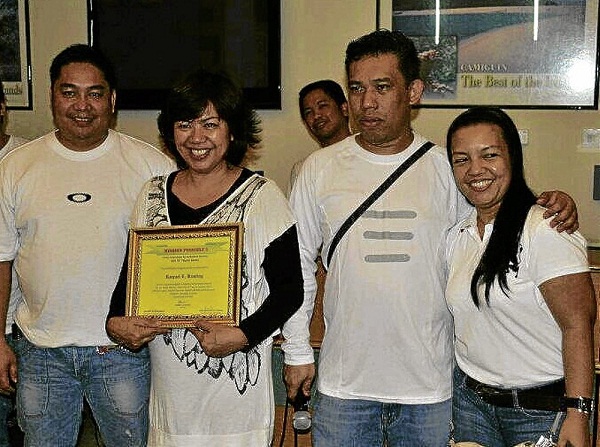
BADGE OF SERVICE From left: Robert, a staffer of the Philippine Overseas Labor Office with Hazel Margarita Parado and Geoffrey during ceremonies last October recognizing outstanding OFWs
Aside from giving first aid and transporting victims to hospitals, DCAS also has big mobile intensive care ambulances.
What they call “Mama units” are ambulances exclusively for emergencies involving a female patients, mostly obstetric or childbirth emergencies.
World’s biggest ambulance
Dubai, by the way, holds the Guinness record for having the largest ambulance in the world. The rich kingdom acquired in 2009 three Mercedes Benz Citaro bus-clinics comprising an operating theater, three intensive care units and eight immediate care units. Two of the clinic-
buses have a length of 12 meters while another is 18 meters long. They are available for rapid medical assistance, particularly in the event of major emergencies with a large number of injury victims. The DCAS has also licensed private air ambulances, also equipped with intensive care units.
Joining DCAS
Geoffrey, from Abra de Ilog, Occidental Mindoro, has been working with the ambulance service for five years now. In the Philippines, he had gained experience in rescue operations as a Red Cross nurse and a member of the UP Mountaineering Society.
“My work is very similar to paramedics in the TV series 911. I am under the ambulance operation department of DCAS. My office is my ambulance rig. An ambulance in Dubai is manned by two nurses and a driver,” explains Geoffrey.
He says weather conditions in the Middle East also make their work challenging.
“Can you imagine responding to a car accident under direct sun of almost 50 degrees Celsius? I have to carry a 20-kilo kit, kneel on concrete hot pavements and lift patients that are sometimes double my weight,” says Geoffrey.
Challenges at work
Hazel Margarita, who takes the calls, has been working six years as an emergency medical dispatcher. She immediately guides callers on first aid steps while locating and dispatching the nearest available ambulance.
Margarita’s job requires her to have knowledge of the Arabic language as well as familiarity with the streets and landmarks in Dubai to be able to guide the ambulances  to the caller’s location.
A nurse needs to be able to imagine or picture the situation and guide the caller through initial first aid steps while he or she waits for the ambulance.
Confidence, patience and better judgment are needed in this kind of work, sums up Hazel Margarita.
Staying cool
The Filipino sense of humor and natural adaptation to any environment make them stand out among others, believes Hazel Margarita.
“We are hard working. In spite of the difficulties of any emergency situations, we show coolness and manage to smile and laugh,” she asserts.
Geoffrey, for one, is more than just an ambulance nurse. He has organized a mission for distressed OFWs housed at the Philippine labor office in Dubai.  The project is implemented in coordination with Migrante Dubai, a private organization for the protection of Filipino migrants.
Geoffrey has also initiated humanitarian activities like the packing of goods for relief in troubled areas in Gaza and Pakistan. He was endorsed by the operations manager of DCAS to the Dubai Red Crescent where he has become one of its few Filipino volunteers.
“Wherever we are, we love what we are doing. We are always motivated, not only by financial gain, but even more by our commitment to service to others,” adds Robert.